Ensuring Syntactic Interoperability Using Consumer-Driven Contract Testing
Note: This is an opinionated summary of a research paper by the first author. The opinions expressed exceed the scientific insights from the study. You can download the original study here.
TL;DR
- What: Consumer-driven contract testing (CDCT) tests API compatibility in isolation using contract files
- When: Use for known consumers, consumer-driven APIs, and when you have organizational buy-in
- Benefit: Catch breaking changes early without expensive integration tests
- Cost: Significant learning curve and cultural shift required
The Integration Testing Challenge
When you split a monolithic application into microservices, something fundamental changes: compilers can no longer prevent syntactic incompatibilities between services. In a monolith, the compiler ensures that function calls match their definitions. But with microservices communicating over HTTP or message queues? Teams must handle this manually.
This creates a serious problem: invalid API calls only surface at runtime, often in production. Traditional testing approaches fall short:
| Approach | Speed | Coupling | Organizational Overhead |
|---|---|---|---|
| Unit Tests | Fast | High (manual sync needed) | Low |
| Integration Tests | Slow | Medium | High (unclear ownership) |
| CDCT | Fast | Low | Medium (needs buy-in) |
- Unit tests would require manual synchronization of tests on both consumer and provider sides, introducing the tight coupling that microservices are meant to avoid.
- Integration and system tests can catch these issues, but they’re expensive, slow, and provide delayed feedback in CI pipelines. Beyond technical complexity, they introduce organizational challenges: Who owns the integration tests? Which team maintains them? When should they run? Coordinating between teams to keep these tests working becomes a bottleneck, especially as the number of services grows.
Microservices make this challenge worse through polyglot tech stacks and independent deployments. Each service can use different programming languages and frameworks, and teams deploy on their own schedules. Without proper safeguards, a provider team can unknowingly break consumers with a single deployment.
What is Consumer-Driven Contract Testing?
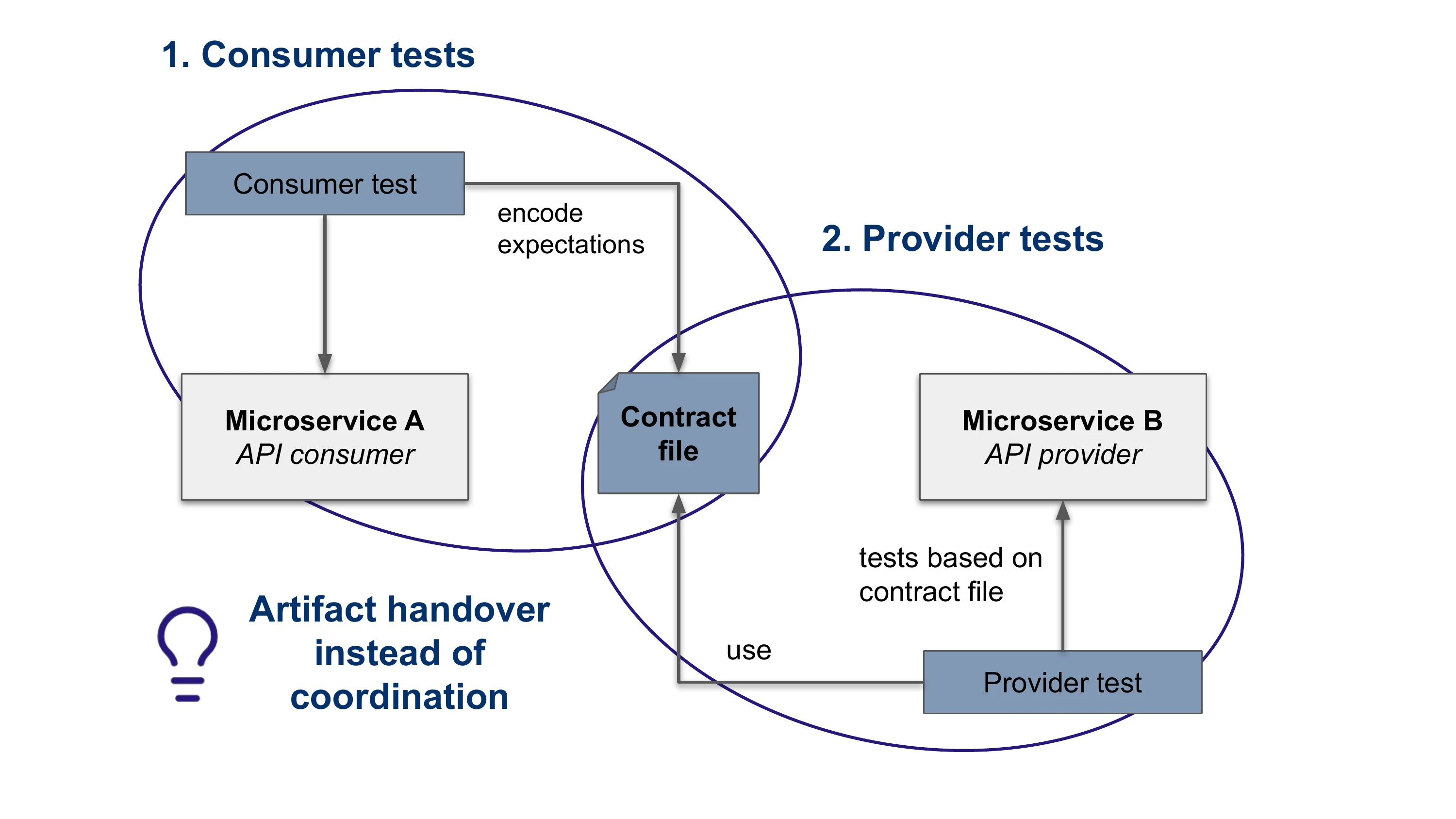
Consumer-driven contract testing (CDCT) offers an elegant solution: test compatibility in isolation by splitting the test into two phases.
Here’s how it works:
- Consumer test runs → encodes expectations into a contract file (required fields, data types, status codes, etc.)
- Contract is handed over → to the provider team as an artifact
- Provider test runs → replays interactions against the provider to verify compatibility
This decoupling is powerful: consumers and providers can be tested independently, without running both simultaneously. Instead of two teams having a call where they reason about the API (expensive coordination), the coordination is simplified to an artifact handover (the contract file). The team of the API providing microservice can use this contract file independent of place (e.g., in another code repository) and time (e.g., in the CI pipeline of the API providing microservice) to test for syntactic interoperability.
The most popular tool to implement consumer-driven contract testing is Pact.
When Should You Use Consumer-Driven Contract Testing?
Based on our systematic literature review of 11 academic publications and action research study, use consumer-driven contract testing when:
1. The Pool of API Consumers Is Limited and Known
Consumer-driven contract testing works best when you know who your consumers are (so it is not a public API). Each consumer creates a contract, and the provider tests against all of them. This approach scales well with a handful to dozens of consumers, but becomes unwieldy if you have hundreds of unknown external consumers.
Sweet spot: Between internal microservices, between UI applications and backend microservices.
2. You Want Consumer Needs to Drive Your APIs
Traditional API development often has providers dictate the interface. Consumer-driven contract testing inverts this: consumers specify what they need, and providers ensure they deliver it. This works particularly well when:
- Multiple consumer teams depend on a shared service
- You want to avoid over-engineering APIs with unused features
- Provider teams need visibility into how their APIs are actually used
Contracts can become excellent coordination artifacts between teams, making consumer expectations explicit without requiring constant synchronous coordination.
3. You Have Resources to Learn and Apply It Consistently
The honest reality: consumer-driven contract testing has a learning curve. Developers in our study spent most of their initial time learning the technique. Effort to write consumer-driven contract tests fell somewhere between unit tests (less effort) and service black-box tests (more effort) for most developers.
Critical success factor: In a follow-up evaluation in industry (not in the paper), we observed that especially writing the consumer tests is a lot of effort that needs to be distributed across the microservice teams. In their case, the adopting team did not get the buy-in from other teams to apply the testing technique consistently!
Benefits We Observed
Beyond preventing breaking changes, we discovered several secondary benefits:
Faster Developer Feedback: Isolated tests mean faster execution and clearer failure messages. No more debugging integration test failures across multiple services.
Improved Code Quality: Developers refactored consumer code for better testability, often introducing dependency injection and improving separation of concerns.
Better API Design: Taking the consumer’s perspective revealed inconsistencies. One developer redesigned endpoints to avoid requiring an extra fetch operation. Another refactored to adopt the robustness principle (Postel’s Law)—only parsing fields the consumer actually needs.
Works Across Communication Patterns: We successfully tested both HTTP-based (REST) and AMQP-based (message queue) interactions. The approach generalizes beyond just synchronous request-response. However, for AMQP-based interactions, the tooling felt less mature and introduced overhead (not using a mock server like for HTTP requests).
Take-Away for Practitioners
1. Consumer-Driven Contract Testing Requires a Cultural Shift
Most microservice projects don’t operate with a consumer-driven API evolution perspective. APIs are typically designed by provider teams based on their internal domain model, with consumers adapting to whatever interface is offered, or in close coordination between provider and consumer teams.
Consumer-driven contract testing fundamentally changes this dynamic—consumers explicitly encode their expectations, and providers commit to fulfilling them.
Key Insight: This is more than a testing technique; it’s an organizational pattern.
Only adopt consumer-driven contract testing if you want to transition toward consumer-driven API development. If your organization isn’t ready for that shift, you’re fighting against the grain. The technique will feel like overhead rather than enablement.
2. The Adoption Effort Is Substantial
Be honest about the investment required. Here are some time-intensive aspects to have on the radar when adopting consumer-driven contract testing:
- Learning curve: Understanding the concept and the tooling, and creating a first prototype is initial effort.
- Setup complexity: CI/CD integration, contract exchange, and test infrastructure requires significant design work
- Writing tests: Consumer tests took more effort than unit tests but less than full integration tests
- Team coordination: Getting buy-in across teams is challenging—each consumer team must invest in writing tests
In a follow-up evaluation in industry (not covered in the paper), a team tried to adopt consumer-driven contract testing but failed to get buy-in from other microservice teams. Without consistent adoption across consumers, the technique provides limited value.
Important note: We will be writing about an alternative approach using static code analysis that reduces the adoption burden. Stay tuned for an upcoming article on how to ensure syntactic interoperability with less manual effort.
3. Consumer-Driven Contract Testing Complements, Doesn’t Replace
Consumer-driven contract tests serve one specific purpose: ensuring syntactic interoperability between services. They validate that:
- Required fields are present
- Data types match expectations
- HTTP status codes align with consumer assumptions
- API endpoints exist and respond as expected
They do not test:
- Business logic correctness
- End-to-end workflows
- Performance characteristics
- Error handling behavior
Always embed consumer-driven contract testing as part of a broader testing architecture. Here’s what worked well for us:
- Unit tests for business logic
- Service black-box tests for functional requirements
- Consumer-driven contract tests for syntactic interoperability
- System tests as smoke tests
4. Start with a Prototype
Don’t roll out consumer-driven contract testing across your entire architecture on day one. Start small:
-
Pick one consumer-provider pair: Choose an integration that changes frequently or has caused breaking changes in the past.
-
Solve the contract exchange challenge early: This is consistently reported as one of the hardest parts. For anything beyond a proof-of-concept, use a contract broker like Pact Broker.
-
Integrate with CI/CD from the start: Contract tests are most valuable when they catch breaking changes automatically. Design the CI integration as part of your prototype, not as an afterthought.
-
Test both synchronous and asynchronous patterns: If your architecture uses both HTTP and messaging, ensure your prototype covers both. The tooling maturity differs—HTTP testing with Pact is well-established, while message-based testing may require more manual setup.
-
Evaluate the value before expanding: After your prototype, honestly assess whether the benefits justify the costs. Did it catch issues? Did teams find it helpful? Was the feedback loop faster? Only expand if the answer is clearly yes.
Learn More
📄 Download the full paper (PDF)
Published in Software Testing, Verification and Reliability, 2025.
Full Citation:
Schwarz, G.-D., Quast, F., & Riehle, D. (2025).Ensuring syntactic interoperability using consumer-driven contract testing.Software Testing, Verification and Reliability, 35, e70006.https://doi.org/10.1002/stvr.70006License: This article is published as open access under the CC BY 4.0 license, which permits use, sharing, adaptation, distribution and reproduction in any medium or format, as long as you give appropriate credit to the original authors and source.
Supplementary Materials: The complete datasets and replication package including code diffs from the action research iterations, interview guides, and the thematic analysis code system are available on Zenodo.
This research was conducted at Friedrich-Alexander-Universität Erlangen-Nürnberg, combining a systematic literature review with participatory action research to build a theory of consumer-driven contract testing. The study was funded by the German Federal Ministry of Education and Research (BMBF Software Campus 2.0, project 01IS17045) and the German Research Foundation (DFG Research Grants Programme RI 2147/9-1).