A Taxonomy of Microservice Integration Techniques
Note: This is an opinionated summary of a research paper by the first author. The opinions expressed exceed the scientific insights from the study. You can download the original study here.
The Hidden Complexity of Microservices
When teams adopt microservices, they often focus on the technical benefits: independent deployability, scalability, and technology diversity. However, our research published in Information and Software Technology reveals a more complex reality: microservice integration is a socio-technical phenomenon that extends far beyond technical aspects.
After analyzing over 60 research papers and conducting six expert interviews across diverse industry contexts, we identified 121 integration techniques organized into a comprehensive taxonomy. What we discovered challenges the impression that microservices are primarily a technical architecture decision.
Key Insights from the Research
1. Microservice Integration Has Three Distinct Dimensions
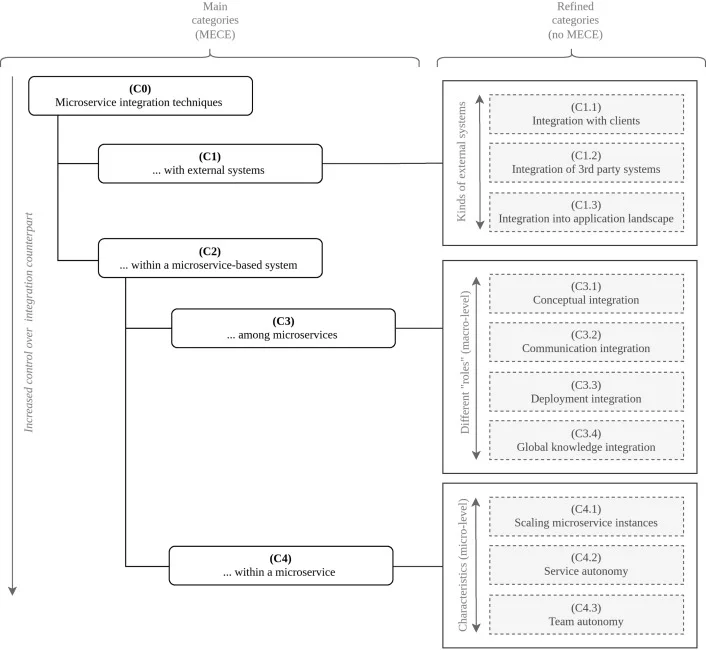
We found that microservice integration challenges fall into three main categories, distinguished by the level of control teams have over the integration counterpart:
Integration with External Systems (Low Control)
- Limited ability to make changes
- Requires special resilience measures to integrate
- Third-party APIs and legacy systems, integration into an enterprise landscape
Integration Among Microservices (Medium Control)
- Requires coordination and negotiation between teams, but changes are possible
- Communication overhead varies (in-house vs. subcontractors)
- Spans conceptual, communication, deployment, and organizational aspects
Integration Within a Microservice (High Control)
- Full team control
- Lower coordination effort
- Enables microservice characteristics like horizontal scalability and autonomy
2. The Organizational Challenge Is Underestimated
One of our most striking findings came from comparing academic literature with practitioner interviews. While literature heavily emphasizes technical solutions like containers (mentioned in 47 papers), CI/CD (35 papers), and load balancing (31 papers), practitioners spent most time discussing organizational challenges:
- Establishing common cultural values across teams
- Making decisions through thematic boards
- Standardization efforts
- Building cross-functional teams
- API versioning strategies
As one interviewee told us (translated from German):
What I would like to impart is the awareness of the consequences [of doing microservices] and of the people’s required education with regard to the challenges of distributed systems on management, business, and also IT level. In my opinion, this happens far too rarely.
3. The Service Cut Shapes Everything
The initial decomposition of your application into microservices, the “service cut”, has cascading effects on every integration challenge you’ll face. Get it wrong, and you will have a hard time working around that mistake.
One expert emphasized:
Today, not a single microservice project has to fail because of technology. Technology is available, it’s good, it’s established, and it has been tested in large projects to maturity. Usually, the projects fail because of a wrong [service] cut.
We identified nine different approaches to service decomposition:
- By Domain-Driven Design
- By functional proximity
- By data entities and consistency needs
- By non-functional characteristics
- My personal favorite: By use-case (coming from a UI driven perspective)
- And more…
Each approach involves trade-offs that directly impact how services must integrate later.
4. The Knowledge Barrier Is Real
Microservices require fundamentally different skills than monolithic development:
- Distributed systems thinking: Network failures become common, not exceptional
- API versioning: Changes must be backward-compatible across service boundaries
- Domain-driven failure handling: Using business logic to gracefully degrade when dependencies fail
- Operational skills: Each team needs DevOps capabilities, ending up operating Kubernetes clusters is almost not avoidable
As one interviewed consultant noted (translated from German):
Many people don’t realize that a microservice application […] is a highly complex distributed application with all the problems that distributions and automatic scaling entail. […] Platforms can provide support, but I have to understand what they do.
What This Means for Practitioners
1. Evaluate Your Service Cut Carefully
The initial decomposition shapes everything that follows. Invest time in getting it right through domain analysis and proof-of-concepts. Consider consistency needs, data flows, and team boundaries before committing to a service cut.
2. Tooling Is Necessary But Not Sufficient
Containers, Kubernetes, service meshes, and CI/CD pipelines are table stakes. They solve infrastructure complexity but don’t address the organizational and architectural challenges. Build cross-functional teams aligned with service boundaries, establish lightweight coordination mechanisms between teams, and create systematic learning pathways for distributed systems knowledge.
3. Address the Human and Organizational Dimensions
Our taxonomy reveals that roughly one-third of integration techniques are organizational or process-oriented. Success requires education at all organizational levels, cultural alignment on values and practices, and shared understanding of the domain and architecture. Specific techniques include:
- Cross-functional teams to reduce coordination overhead and knowledge barriers
- Thematic boards for distributed decision-making across services
- Standardization (where appropriate) to reduce cognitive load
- Regular cross-team discussions to prevent silos and integration friction
4. Design for Failure from Day One
Network calls will fail. Services will be unavailable. Data will be inconsistent. Essential patterns include:
- Circuit breakers and fail-fast patterns for service instance recovery
- Compensating transactions to avoid inconsistent states
- Domain-driven degradation to stay operable when dependencies fail
- Bounded retries with exponential backoff for transient failures
- Dead letter queues for eventual issue resolution
5. Integration Spans All Architectural Layers
Don’t think of integration as purely backend-to-backend communication. Design both technical pathways (APIs, events, micro-frontends, service discovery) and human pathways (documentation standards, shared vocabularies, collaboration patterns). Every integration decision involves trade-offs between performance, consistency, complexity, and coupling.
6. The Human Element: Most Problems Arise from People, All Are Solved by Them
While this quote wasn’t from the paper itself, it captures the essence of our findings: microservices are fundamentally a socio-technical challenge. The complexity shifts from code into the integration layer, which necessitates enhanced collaboration among developers, architects, operators, and management. Technology enables microservices, but people make them work.
Learn More
📄 Download the full paper (PDF)
Published in Information and Software Technology, Volume 183, 2025.
Full Citation:
Schwarz, G.-D., Bauer, A., Riehle, D., & Harutyunyan, N. (2025).A taxonomy of microservice integration techniques.Information and Software Technology, 183, 107723.https://doi.org/10.1016/j.infsof.2025.107723License: This article is published as open access under the CC BY 4.0 license, which permits use, sharing, adaptation, distribution and reproduction in any medium or format, as long as you give appropriate credit to the original authors and source.
Supplementary Materials: We used the taxonomy and the found integration techniques to create a digital handbook for microservice integration. The complete taxonomy with all 121 integration techniques, their context-problem-solution descriptions, and traceability to sources is available here.
This research was conducted at the Friedrich-Alexander University Erlangen-Nürnberg in collaboration with Blekinge Institute of Technology, examining the multi-dimensional aspects of microservice integration through systematic literature analysis and expert interviews. The study was funded by the German Federal Ministry of Education and Research (Software Campus 2.0) and the German Research Foundation.